
The training and professional system in the Piedmont Region is undergoing a profound transformation in how skills are certified and valued. An analytical survey conducted by the European project MiCRET (Microcredentials for the Renewable Energy Transition), in collaboration with the Piedmont Regional Authority, has mapped the current state of this transition. The report, based on 91 responses from a diverse sample — 70% vocational training entities and 22% companies, alongside consultancies and institutions — provides a detailed overview of the adoption dynamics for new certification technologies.
The Digital Transition
The analysis of the adoption rate of digital tools over the last three years reveals a significant polarization within the regional system. While 59% of respondents report still relying on traditional or paper-based methods, 41% have already integrated digital tools into their certification processes. This figure does not suggest a lack of interest in innovation, but rather a division between a group of “engaged innovators” already operational and a majority of “potential adopters” who require a clearer shared framework and accessible technical tools to initiate change.
A fundamental reflection emerging from the survey concerns the ambiguity between administrative digitalization and genuine credential innovation. Many entities associate the use of the mandatory regional management system (“Attesta”) with digital adoption. However, the real challenge for the Piedmont system lies in moving from bureaucratic dematerialization to the gradual adoption of open standards, such as Open Badges and microcredentials, capable of providing greater transparency and real-world employability to short and targeted training pathways.
Open Badges
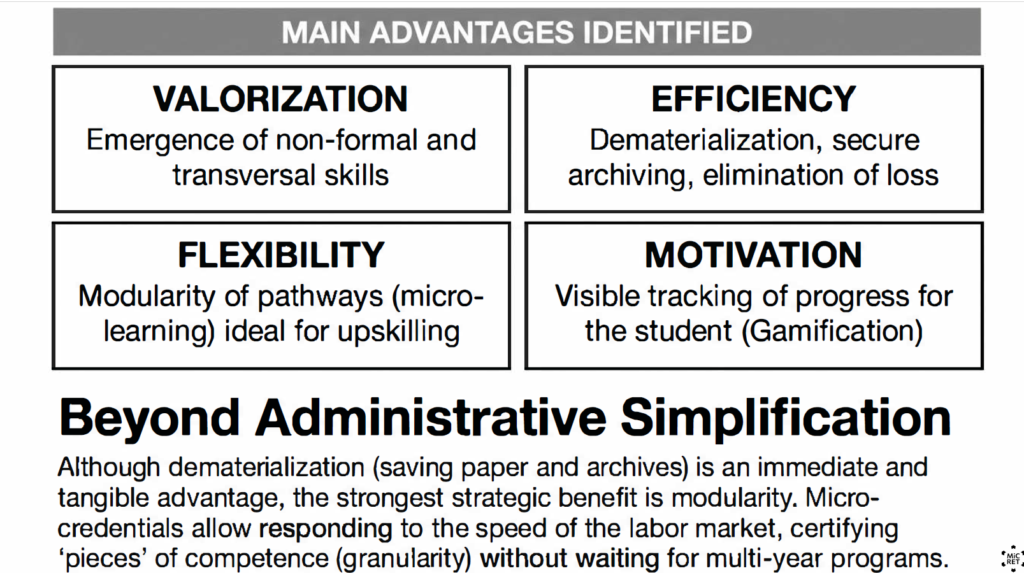
The adoption of Open Badges is proving particularly effective in valuing transversal skills (soft skills), which traditional diplomas and qualifications often fail to track granularly. These digital tools allow for “making the invisible visible,” certifying abilities such as problem-solving, teamwork, and effective communication acquired in non-formal contexts.
The value of this approach is confirmed by several concrete experiences in the Piedmont area:
- CNOS-FAP: has implemented digital badges to certify interpersonal and cooperation skills in projects such as “LabsToLearn” and “Green is Now,” primarily aimed at adolescents.
- Casa di Carità Arti e Mestieri: uses these tools to attest to skills emerging during simulation and role-playing activities.
- Colline Astigiane: employs microcredentials in the Erasmus+ PATCH project, focused on the job placement of individuals with cognitive disabilities, where learning modularity is a critical success factor.
These cases demonstrate how technology can provide dignity and visibility to skills essential for employability, facilitating the match between labor demand and supply through a more accurate description of the candidate’s professional profile.
Blockchain and Security
While Open Badges excel in valuing skills, Blockchain technology addresses a different but equally crucial need: data certainty and immutability. In high-criticality areas such as workplace safety, the shift from paper certificates to digital credentials on Blockchain represents a significant step forward in terms of traceability and operational efficiency.
The case of the Formedil Construction School of Asti is emblematic of this evolution. The entity uses QR Codes linked to Blockchain for safety certificates and equipment authorizations. The advantages of this system are manifold:
- Anti-counterfeiting: The immutability guaranteed by Blockchain makes it impossible to forge qualifications.
- Immediate Verifiability: On-site or in the company, scanning a QR Code is sufficient to confirm the validity of the operator’s training in real-time.
- Logistical Efficiency: It eliminates the risks of losing or damaging physical documents, ensuring constant and secure access to the worker’s training history.
The ITS Academy ICT Piedmont is also adopting similar solutions, issuing “Diplomas on Blockchain” to allow recruiters immediate and secure verification of candidates’ qualifications.
Toward an Integrated Ecosystem
The findings of the MiCRET survey highlight a shared need among operators: the development of clearer shared guidelines and good practices that can support the gradual and coherent integration of microcredentials within the regional training system — in a way that is complementary to existing tools and measures, rather than replacing them.
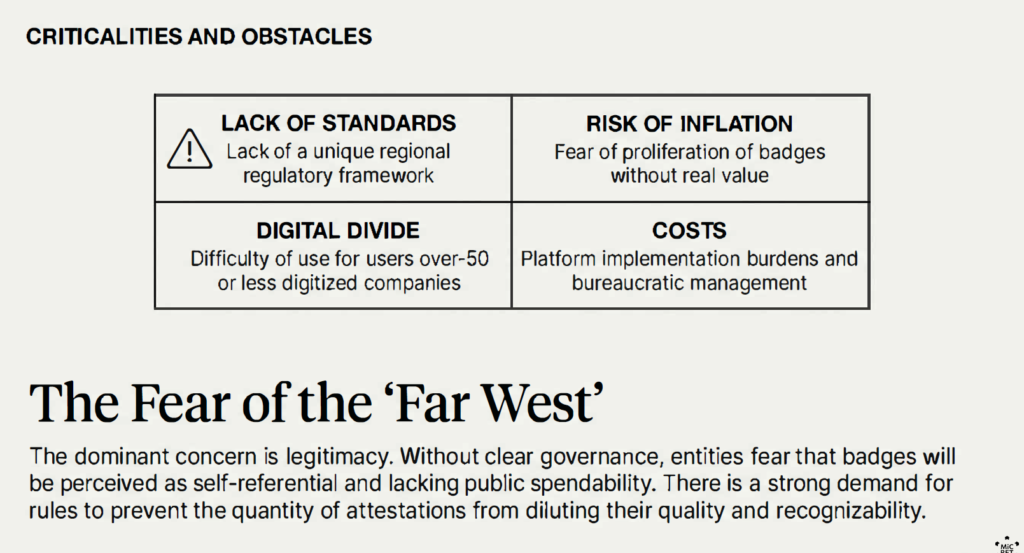
The Piedmont Regional Authority has initiated a consultation and reflection process with the sector’s key stakeholders, with the aim of identifying good practices and exploring possible orientations to facilitate the recognition of microcredentials within the regional context. This is a careful and participatory path, consistent with the complexity of a regulatory landscape where distinctions — between validation and certification, between institutional recognition and informal acknowledgement — carry significant administrative and legal implications for public bodies and training operators alike.
A Statement from Regione Piemonte
To further clarify the institutional framework and the results of recent regional monitoring, Teresa Valentino, Head of the Skills Certification Office (Training Standards and Permanent Guidance Sector) for Regione Piemonte, shares the following perspective:
“Regione Piemonte is one of the associated partner of MiCRET project and aims to observe and contribute, when possible, to theoretical and practical outcomes from this transnational experience on microcredentials theme. Since 2022 European Council Recommandation on microcredentials a great debate has started about these new stackable objects and European Union is pushing forward reflections and applications about them. In 2025 also Regione Piemonte has introduced in its own legislation on Labour, Vocational Training and Education, a specific focus on developing microcredentials recognition in regional system.
As a new element microcredentials though, follow old principles like recognition of creditis, ECVET policy, stackability, transparency which are all in place in our certification system since the early 2000s.
The principal approach of Regione Piemonte then is to observe, describe and analyse what microcredentials are and which standards should respect to be considered as valuable in a mature credit and certification system as Regione Piemonte.
We started from observing and, first of all, launch a on line survey among the whole accredited bodies in order to map a clear situation about which use our system does of microcredentials. 72 bodies answered the survey and out of 71 answers, only 40% – 29 survey respondents – have tested this new objects and very often outside Regional Register which again pose a crucial question: should microcredentials be outside or inside the Qualification Framework? Should they be at least related to this framework? Are they within or outside the certification system?
More of these questions will find an answer in the project that Regione Piemonte is implementing on its territory and of course the discussion can find valuable exchanges, practices and inputs from MiCRET.”
The priority requests emerging from the MiCRET survey are clear and point toward creating a solid institutional framework:
- Standardization: Alignment with the European Qualifications Framework (EQF) and the Regional Repertory of Skills is considered essential to ensure coherence and transferability.
- Interoperability: Operators request that new digital tools be technically integrated with existing systems (such as “Attesta”) to avoid unnecessary data duplication and administrative burdens.
- Promotion and Validation: An information campaign directed at companies is needed to help them understand the potential value of microcredentials, alongside broader reflection on how non-formal learning can be better acknowledged within existing frameworks.
In conclusion, the modularity offered by microcredentials and the security guaranteed by Blockchain represent promising building blocks for a more responsive and transparent training system. The path ahead for Piedmont is one of careful, shared exploration — supporting ‘potential adopters’ in understanding and adopting these tools, while ensuring that the credentials issued carry real and consistent value across institutional and professional contexts.