
The European Green Deal is facing a quiet but critical structural hurdle: we are rapidly building a modern, decentralized, data-heavy energy grid, but our workforce training models are stuck in the past.
As renewable energy systems become more complex, technicians can no longer rely solely on traditional mechanical installation skills. Today’s smart grids require a workforce capable of navigating what the European Union calls the Twin Transition—the simultaneous shift toward green energy and deep digital integration.
A recent technical report by the MICRET (Microcredentials for Renewable Energy Technicians) project highlights a massive gap in how the workforce is being prepared for this reality, and offers a concrete blueprint to fix it.
The “Digital Vacuum” in Technical Training
The core finding of the MICRET audit points to a major imbalance: while mechanical installation training is widely available across Europe, there is a severe shortage of digital security and data literacy training for field personnel. In fact, research shows that fewer than 5% of existing vocational education and training (VET) programs incorporate the data literacy and cybersecurity skills necessary to manage modern grids safely.
This mismatch is labeled the “Digital Vacuum.” A technician might know exactly how to physically mount a solar array or inspect a wind turbine blade, but they are rarely taught how to troubleshoot a real-time load balancing system, interpret SCADA data, or identify an IoT threat on a smart meter.
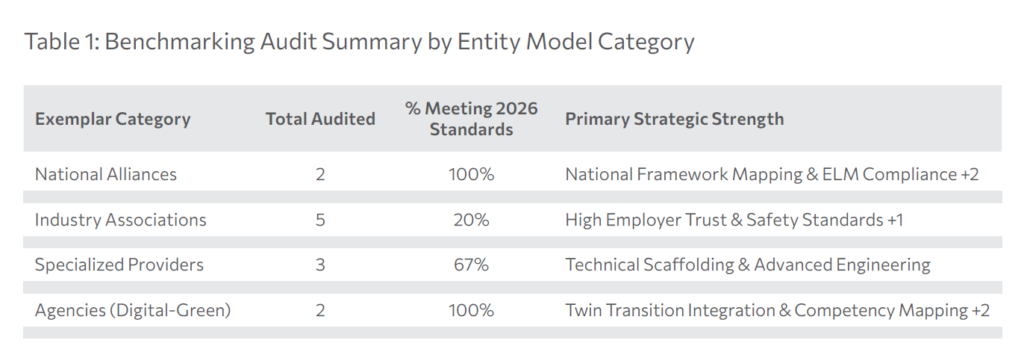
Compounding this problem is a lack of standardization. Long-form, multi-year degrees take too long to adapt to rapid technological shifts. Meanwhile, short-form courses offered by industry associations often lack the formal metadata, European Credit Transfer (ECTS) alignment, and digital verification infrastructure required for cross-border recognition. The report reveals that only 30% of surveyed training schemes currently meet the full 2026 Trust Standards for machine-readable data, industry co-design, and framework alignment.
The Fix: 15-to-40-Hour “Stackable” Microcredentials
To bridge this 70% trust and skills gap, the MICRET project argues against replacing current programs entirely. Instead, the solution lies in strategic adaptation: breaking down dense, complex, long-form curricula into tight, bite-sized learning units called microcredentials.
According to the 2026 standards established by the World Alliance for Microcredentials (WAM), these units must meet distinct criteria to be effective:
Granular Workload: Programs must be condensed into targeted 15-to-40-hour units optimized for working professionals.
The “Digital-Green” Fusion: Every technical green module must natively integrate a digital competency layer (such as AI orchestration, IoT security, or automated diagnostics).
Instant Portability: Credentials must use machine-readable metadata compatible with the European Learning Model (ELM) and digital wallets like Europass. This ensures an employer can instantly verify a technician’s qualifications without bureaucratic delays.
Stackable Design: These short bursts of learning must act as building blocks that cleanly stack toward larger diplomas or full national certifications.
Global Models That Work
The transition to this system isn’t purely theoretical; it builds upon proven global elements:
The Irish National Alliance (MicroCreds.ie): Serves as a primary reference point for converting university-level renewable energy training into portable, 5-ECTS microcredentials that hold full legal weight under national qualifications frameworks.
The Global Wind Organisation (GWO): Represents the industry gold standard for verification via its centralized WINDA database, allowing instantaneous HR verification of safety records worldwide.
American Clean Power (ACP): Demonstrates the power of direct employer co-design, ensuring that training units are explicitly validated by hundreds of member companies to guarantee immediate labor-market value.
By blending the high industry trust of organizations like GWO and ACP with the strict digital architecture of the Irish and EU frameworks, the MICRET blueprint outlines a standardized path forward for European vocational schools and employers alike.
From Blueprint to Reality: 10 Core Configurations
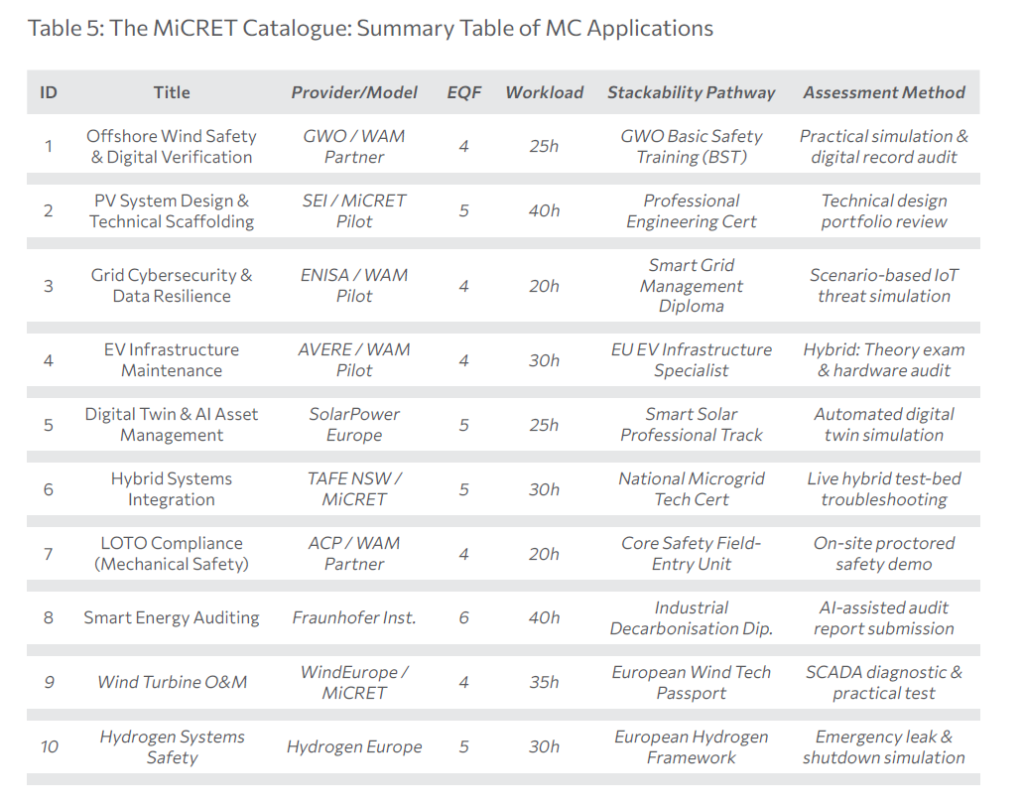
To prove that this model is achievable, the report details ten specific microcredential configurations tailored for modern technician workflows. These are designed to take existing industry expertise and supercharge it with a digital or safety validation layer.
For instance, a traditional gas technician can transition into the green hydrogen sector via a 30-hour Hydrogen Systems Safety unit covering ATEX explosive atmosphere compliance and digital leak sensor calibration. Similarly, a solar installer can level up into a 25-hour Digital Twin & AI Asset Management course to master remote, predictive maintenance instead of relying on reactive, manual inspections.
Other critical blueprints include Grid Cybersecurity & Data Resilience (a 20-hour module focusing on IoT threat detection for smart meters) and EV Infrastructure Maintenance (a 30-hour unit handling high-power charging station mechanics and Vehicle-to-Grid protocol management).
A Move Toward Workforce Mobility
As Europe races toward its 2030 and 2050 climate targets, treating workforce education as an afterthought is no longer an option. Transitioning to a modular, digitally verifiable microcredential ecosystem provides the common currency needed to close the skills gap and facilitate cross-border workforce mobility. It lowers the barrier to entry for continuous upskilling, ensuring that technicians can evolve at the exact same pace as the technology they are sent out to fix.