
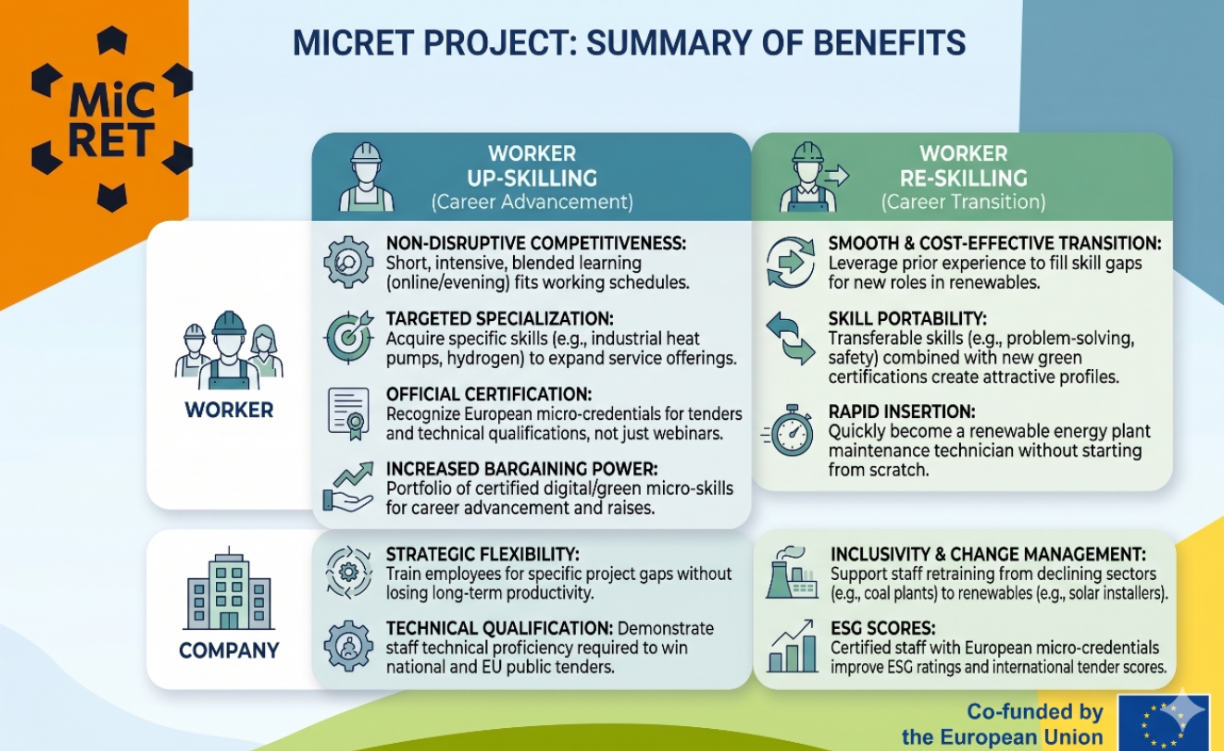
Beside focusing on the “new generation” of the workforce and students, it is important to highlight how the MiCRET project ecosystem serves as a strategic tool for adult workers and companies in the CleanTech and renewable energy sectors. Driven by the dual ecological and digital transitions, the rapid obsolescence of technical skills requires continuous training. Micro-credentials offer a flexible, portable, and modular solution for upskilling (leveling up within a role) and reskilling (transitioning to a new role) without disrupting careers or business productivity.
Upskilling vs. Reskilling: Practical Examples
The text outlines how institutions like ITS Green Academy are expanding beyond higher education for youths into continuous professional training:
- Upskilling (Leveling Up): Focuses on expanding technical proficiency within an existing sector. For instance, ITS Green Academy hosted a preparatory training course for inspecting heating systems arranged by the Italian firm NEC S.r.l. (New Energy Company).
- Reskilling (Career Transition): Focuses on acquiring entirely new skills to change roles. A major real-world example is the “Jobs for Just Transition” project by Enel in Italy. Located near a coal-fired power plant in Civitavecchia, this inclusive initiative retrained staff from declining sectors. It successfully upskilled 120 local participants through 10 editions (480 total hours) of a photovoltaic installer program, and provided tailored welding certifications to 10 local workers, preparing them for immediate insertion into renewable energy construction sites.
Detailed Breakdown of Benefits
- For the Worker
- Upskilling Challenges & Solutions: Established professionals cannot afford to put their careers on hold for lengthy courses. Micro-credentials solve this by offering short, intensive, and blended training formats (online asynchronous lessons combined with evening or weekend practical workshops). This grants targeted specializations (e.g., an HVAC installer learning state-of-the-art industrial heat pumps or hydrogen systems) and official certification recognized in public tenders, opening new business opportunities.
- Reskilling Challenges & Solutions: Workers transitioning from mature industries or sectors in crisis (like automotive or fossil fuels) often fear they must “start from scratch” or need a full master’s degree. Micro-credentials bridge the gap cost-effectively by leveraging prior experience (like problem-solving or safety) and focusing only on what is missing. For example, a metalworking maintenance worker can quickly retrain in IoT digital diagnostics for wind or solar farms, creating a highly attractive hybrid profile.
- Bargaining Power: Building a portfolio of certified digital and green micro-skills (such as IoT sensor installation or SCADA data interpretation) enables workers to successfully negotiate pay raises, career advancements, or supervisor roles.
- For the Company
- Strategic Flexibility: Instead of losing an employee’s productivity for extended periods, companies can fund targeted micro-courses to fill exact skill gaps for upcoming projects.
- Competitive Edge: Having staff certified with European micro-credentials officially demonstrates technical qualification, which boosts the company’s scores in ESG ratings and international public tenders.
Through collaborations between the MiCRET project and field partners like ITS Green Academy, continuing education is being transformed from a rigid bureaucratic requirement into an agile management tool. It empowers Europe’s adult workforce to actively manage and thrive alongside rapid technological change rather than merely enduring it.